
TOP

PRODUCTS
 Home > Products


Product Overview
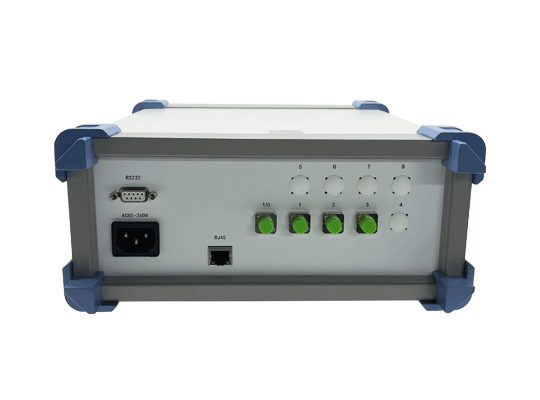
The OSW‑1550PM‑1×3‑0‑FA is a high‑performance polarization‑maintaining optical switch custom‑developed by Coreray (www.coreray.com) for applications that demand strict polarization control. This 3‑input, 1‑output switch operates in the C‑band (1540‑1565 nm) with a center wavelength of 1550 nm, utilizing PM1550 fiber and FC/APC connectors to ensure minimal reflection and excellent polarization extinction ratio. Housed in a benchtop metal enclosure, it offers both manual push‑button and RS232 remote control, making it ideal for laboratory test systems, fiber sensing, and industrial networks where signal integrity and flexibility are paramount.
· High Polarization Extinction Ratio (PER) – Minimum 20 dB (typical 25 dB) ensures stable polarization state during switching, critical for coherent communication and sensing.
· Low Insertion Loss – ≤0.8 dB typical, ≤1.2 dB over full temperature range, preserving signal power.
· Fast Switching Response – ≤10 ms switching time enables real‑time test automation and protection switching.
· Dual Control Modes – Front‑panel channel selection buttons plus RS232 serial interface for local and remote operation.
· Industrial Reliability – Operating temperature -10 to +60°C, storage -40 to +85°C, and lifetime ≥1 million cycles.
· Compact Benchtop Enclosure – Metal housing (200×150×80 mm) with anti‑EMI design, easily integrates into lab or industrial setups.
Parameter | Unit | Value | Remarks |
Optical | |||
Wavelength Range | nm | 1540 – 1565 (center 1550) | C‑band, compatible with DWDM systems |
Insertion Loss (Typ.) | dB | ≤0.8 | @25°C |
Insertion Loss (Max.) | dB | ≤1.2 | Over -10 to +60°C |
Polarization Extinction Ratio (Typ.) | dB | ≥25 | Key PER performance |
Polarization Extinction Ratio (Min.) | dB | ≥20 | Over full temp range |
Crosstalk (Isolation) | dB | ≥60 | High channel isolation |
Mechanical | |||
Switching Time | ms | ≤10 | |
Lifetime | cycles | ≥1,000,000 | Full load switching |
Fiber Type | PM1550, φ0.9 mm loose tube | ITU‑T G.657 compliant, flexible | |
Pigtail Length | m | 1.0 (customizable) | |
Connector Type | FC/APC | Low reflection, high precision | |
Environmental | |||
Operating Temperature | °C | -10 to +60 | Industrial grade |
Storage Temperature | °C | -40 to +85 | |
Operating Humidity | %RH | 10 – 90 (non‑condensing) | |
Storage Humidity | %RH | 5 – 95 (non‑condensing) | |
Electrical | |||
Power Supply | V DC | 5 – 12 | Wide input range |
Control Interface | RS232 + Manual Buttons | Dual‑mode operation | |
Power Consumption | W | ≤5 | Energy‑efficient |
Physical | |||
Switch Configuration | 3×1 (3 inputs, 1 output) | ||
Enclosure | Benchtop, metal | EMI‑shielded | |
Dimensions (W×D×H) | mm | 200 × 150 × 80 | Compact footprint |
Weight | kg | ≤1.5 (without packaging) | Lightweight, portable |
· Optical Communication Test Systems – Automated path switching for efficient multi‑channel testing.
· Fiber Optic Sensing Networks – Time‑division multiplexing and selective signal routing in DAS, temperature, or strain sensing.
· Fiber Optic Test Instruments – Integration into power meters, optical spectrum analyzers, and OTDRs.
· Optical Amplifier Systems – Protection and redundancy switching in amplifier chains.
· R&D Laboratories – Optical path control and signal selection in experimental setups.
· Industrial Fiber Networks – Signal routing in automation and control systems.
1. Power Connection
Use a DC 5‑12 V power adapter (center positive) and connect to the rear‑panel power jack. Ensure correct voltage.
2. Control Mode Selection
o Manual: Press the CH1/CH2/CH3 buttons on the front panel to select the active input channel. The corresponding LED indicates the current channel.
o RS232: Connect the switch to a PC via a serial cable. Default settings: 9600 baud, 8 data bits, 1 stop bit, no parity. Use the provided software or send ASCII commands to switch channels.
3. Optical Connections
Connect input fibers to IN1/IN2/IN3 and the output fiber to the OUT port. Ensure connectors are clean to avoid insertion loss degradation.
4. Maintenance
Regularly clean connector end‑faces with a dedicated fiber cleaner. Avoid mechanical shocks. When not in use, store in a dry, ventilated environment.
· Customizable Options – Pigtail length, connector type (FC/APC, LC/APC, etc.), and fiber type can be tailored to your needs.
· Proven Performance – Every unit undergoes full temperature cycling and burn‑in testing to guarantee reliability.
· Expert Support – As a leading optical switch manufacturer in China, Coreray offers OEM/ODM services and technical assistance.
Q: What is the difference between a PM switch and a standard optical switch?
A: A PM switch maintains the polarization state of the light passing through it, which is essential for systems like coherent communications, fiber interferometers, and certain sensors. Standard switches do not preserve polarization.
Q: Can I control multiple switches from one computer?
A: Yes. Each switch has its own RS232 interface. You can connect multiple switches to a PC using a multi‑port serial adapter and address them individually.
Q: What is the typical PER at 1550 nm?
A: Typical PER is ≥25 dB, with a minimum of 20 dB over the entire operating temperature range.
Q: Does the switch support latching or non‑latching operation?
A: This model is a non‑latching switch; it requires continuous power to maintain the selected path. Latching versions are available upon request.
Q: Can I get a customized version with different fiber lengths or connectors?
A: Absolutely. Contact our sales team with your requirements.
Ordering Information
For quotations or technical inquiries, please email coreray@coreray.cn. Include your desired configuration (fiber length, connector type, etc.) for a prompt response.


Scan to add on WeChat


 中文
中文 EN
EN