
TOP

PRODUCTS
 Home > Products


Product Overview
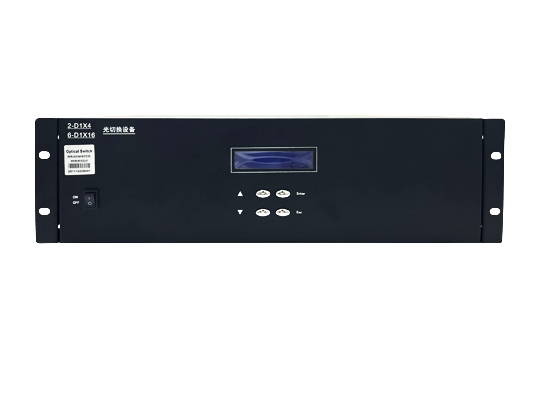
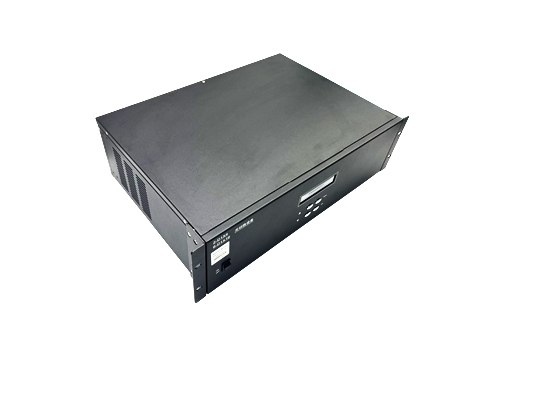
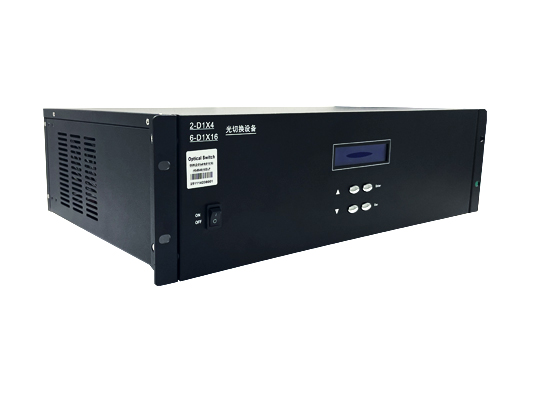
The OSW‑(6‑D1×16 + 2‑D1×4) is a high‑density, remotely managed fiber optic switch designed for applications requiring flexible and reliable optical path switching. It integrates six dual 1×16 switches and two dual 1×4 switches, supporting up to 112 bidirectional fiber channels (based on Tx/Rx pairing). Each switching module can be controlled independently, offering unprecedented flexibility for complex network architectures. Housed in a compact 4U chassis, this switch is ideal for data centers, test systems, and fiber sensing networks.
Key Features
High‑density configuration
6 × dual 1×16 + 2 × dual 1×4 modules provide 112 bidirectional channels (Tx/Rx), enabling dense signal routing in minimal rack space.
Independent control & flexibility
Every individual optical switch can be controlled separately, allowing custom channel grouping and easy system expansion.
High‑speed compatibility
Built with OM3 multimode fiber (50/125 µm) and optimized for 850 nm wavelength, it supports short‑reach high‑speed protocols such as 10G/40G Ethernet.
Compact & robust mechanical design
4U standard chassis with depth of only 350 mm – perfect for space‑constrained racks.
Dual control interfaces
Both RS‑232 serial and Ethernet (TCP/IP) ports are provided for seamless integration into automated control systems.
Reliable power & connectors
Operates on 220 V AC mains and uses LC/PC connectors for low loss and stable connections.
Technical Specifications
Parameter | Value |
Operating Wavelength | 850 nm |
Insertion Loss (Typ.) | < 1.0 dB |
Polarization Dependent Loss (max) | 0.05 dB |
Wavelength Dependent Loss (max) | 0.20 dB |
Temperature Dependent Loss (max) | 0.20 dB |
Repeatability (max) | ± 0.01 dB |
Return Loss (min) | 55 dB |
Crosstalk (min) | 60 dB |
Lifetime | 10⁹ cycles |
Switching Time | ≤ 12 ms |
Max Optical Power | 500 mW |
Control Interface | RS‑232, RJ45 (TCP/IP) |
Power Supply | 220 V AC, single phase |
Fiber Type | OM3 50/125 µm |
Dimensions (W × H × D) | 480 mm × 177 mm (4U) × 350 mm |
Operating Temperature | –20 °C to +70 °C |
Storage Temperature | –40 °C to +85 °C |
Environmental Stress Screening | +85 °C / 48 h baking; |
Pigtail Type / Length | φ0.9 mm loose tube / 0.5 m |
Connector Type | LC/PC |
RoHS Compliant | No (customizable) |
Applications
Data Center Networks – Redundant path switching, link backup, and rapid restoration.
Communication Test Systems – Automated multi‑channel signal monitoring and testing.
Fiber Optic Sensing – Optical path routing in distributed sensing and security monitoring.
R&D Laboratories – Flexible network setup for optical communication experiments.
Broadcast Video Transmission – Scheduling and distribution of multiple video signals.
Control & Operation
The OSW series can be controlled via RS‑232 or TCP/IP commands. Each switching module responds to simple ASCII commands, enabling rapid integration with existing monitoring software. The internal switching mechanism employs either micro‑motor driven actuators or MEMS (Micro‑Electro‑Mechanical System) mirrors, depending on the selected configuration. Both technologies guarantee reliable optical path switching with minimal loss.
Optical path discipline – Tx‑to‑Tx and Rx‑to‑Rx connections must be maintained to ensure correct bidirectional communication. The switch automatically aligns the physical paths according to the command, preserving signal integrity.
Why Choose Coreray’s OSW Series?
Customizable – Choose between MEMS or mechanical switching engines, and specify pigtail lengths, connectors, and labeling.
Proven reliability – Extensive environmental screening (temperature cycling, baking) ensures long‑term stability.
Expert support – As a leading optical switch manufacturer in China, Coreray provides full technical assistance and OEM services.
Frequently Asked Questions
Q: What is the difference between the MEMS and mechanical versions?
A: MEMS versions offer faster switching (≤10 ms) and compact size, while mechanical versions provide extremely low insertion loss and handle higher optical power. The OSW series can be equipped with either technology based on your application needs.
Q: Can I control each 1×16 module independently?
A: Yes. Every dual 1×16 and dual 1×4 switch is individually addressable, allowing you to route signals from different input ports to any output port without interference.
Q: What is the typical insertion loss at 850 nm?
A: Typical insertion loss is below 1.0 dB, with excellent repeatability of ±0.01 dB.
Q: Does the switch support both single‑mode and multimode fiber?
A: This model is optimized for OM3 multimode fiber (850 nm). For single‑mode versions (1310/1550 nm), please contact our sales team.
Q: How do I integrate the switch into my existing network management system?
A: The switch accepts simple ASCII commands over RS‑232 or TCP/IP. We provide a command set and sample code for quick integration.
Ordering Information
To request a quote or discuss custom configurations (connector types, fiber lengths, special coatings), please contact coreray@coreray.cn


Scan to add on WeChat


 中文
中文 EN
EN