
TOP

PRODUCTS
 Home > Products


Product Overview
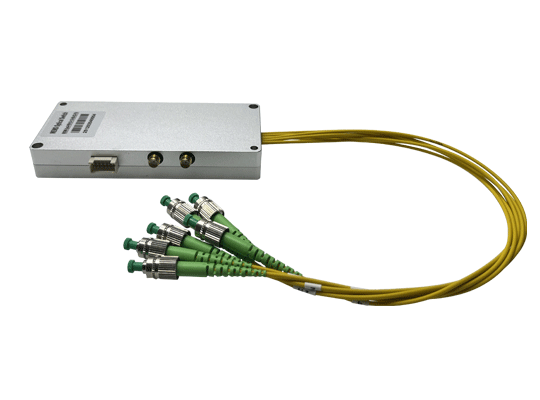
The 2×4 MEMS Polarization-Maintaining (PM) Optical Switch from Coreray represents a state-of-the-art solution for photonic systems where preserving the polarization state of light is critical. Leveraging advanced MEMS (Micro-Electro-Mechanical Systems) micro-mirror array technology, this compact and highly reliable switch enables fast and precise optical path routing from 2 input fibers to 4 output fibers while maintaining exceptional polarization extinction ratio.
Designed for integration into demanding environments, this MEMS optical switch features PM fibers terminated with high-quality FC/APC connectors to ensure minimal back reflection. An integrated SMA electrical interface provides robust and noise-immune connectivity for control signals, making it suitable for laboratory, industrial, and field-deployed systems. Whether used in quantum communication networks, fiber laser systems, or aerospace instrumentation, this switch delivers consistent, high-performance operation.
Key Features
Advanced MEMS Technology: Utilizes a MEMS micro-mirror array for reliable, high-speed optical path switching. This ensures fast switching (≤8ms) and a long operational lifetime (≥10⁷ cycles), ideal for systems requiring frequent reconfiguration.
Polarization-Maintaining Design: Engineered with PM fibers and optimized optical paths to maintain the polarization state of transmitted light, with a high extinction ratio (≥18dB). This is crucial for coherent communication, interferometric sensing, and quantum optics.
Superior Optical Performance: Offers low insertion loss (≤0.8dB), high return loss (≥50dB), and low crosstalk (≥50dB), ensuring signal integrity in sensitive applications.
High Power Handling Capability: Capable of handling optical power up to 500mW, making it suitable for fiber laser routing and high-power test systems.
Robust Control Interface: Equipped with an SMA electrical connector for reliable, low-noise driving signals, ensuring stable operation even in electrically noisy environments.
Compact & Rugged Packaging: Available in two form factors—a miniature core unit (28.0 x 12.6 x 8.5 mm) for tight PCB integration, and a complete module package (450 x 450 x 110 mm) with driver electronics for easy benchtop or rack-mount use.
Wide Environmental Tolerance: Operates reliably from -20°C to +70°C and withstands storage from -40°C to +85°C, with rigorous temperature cycling and baking tests to guarantee long-term stability.
Applications
Fiber Optic Sensing Systems: Enables fast channel scanning in distributed acoustic sensing (DAS), fiber Bragg grating (FBG) interrogation, and interferometric sensors (e.g., gyroscopes) where polarization maintenance is paramount.
Fiber Laser Systems: Used for routing, combining, or switching laser beams in multi-channel fiber lasers, amplifiers, and master oscillator power amplifier (MOPA) configurations.
Test & Measurement Equipment: Ideal for automated multi-channel switching in polarization-dependent loss (PDL) measurements, component characterization, and production testing.
Aerospace & Defense: Provides stable, vibration-resistant optical switching for navigation systems (FOGs), secure communication links, and avionics.
Quantum Communication & Precision Optics: Essential for high-precision control of polarization-maintaining paths in quantum key distribution (QKD) systems, entangled photon experiments, and other quantum optics setups.
Technical Specifications
Optical Performance | Specification |
Operation Wavelength | 1550 nm (custom wavelengths available) |
Insertion Loss (Max.) | ≤0.8 dB |
Uniformity (Max.) | ≤0.2 dB |
Extinction Ratio (Min.) | ≥18 dB |
Wavelength Dependent Loss (Max.) | ≤0.25 dB |
Temperature Dependent Loss (Max.) | ≤0.3 dB |
Repeatability (Max.) | ≤±0.05 dB |
Return Loss (Min.) | ≥50 dB |
Crosstalk (Min.) | ≥50 dB |
Lifetime | ≥10⁷ cycles |
Switching Time (Max.) | ≤8 ms |
Optical Power Handling (Max.) | 500 mW |
Drive Voltage | 5V (TTL/digital compatible) |
Control Interface | SMA connector |
Fiber Type | PM Panda fiber, 9/125µm |
Pigtail Length | 0.35 m (customizable) |
Connector Type | FC/APC |
Core Dimensions (L x W x H) | 28.0 x 12.6 x 8.5 mm |
Module Dimensions (L x W x H) | 450 x 450 x 110 mm |
Operating Temperature | -20°C to +70°C |
Storage Temperature | -40°C to +85°C |
Environmental Screening | Baking: +85°C/48Hr; Temp. Cycling: -40°C to +85°C/48Hr |
Working Principle
The 2x4 MEMS PM optical switch operates by applying an electrical control signal (TTL or digital) via the SMA interface to the MEMS actuator. This signal precisely adjusts the angle of a micro-mirror array. Incident light from one of the two input PM fibers is reflected by the MEMS mirror and directed into the desired output PM fiber among the four ports.
The entire optical path—from input fiber, through MEMS mirror, to output fiber—is meticulously designed to preserve the polarization state. The MEMS structure and fiber alignment minimize stress-induced birefringence and polarization crosstalk, ensuring a high extinction ratio. This non-latching design allows the mirror to hold its position without continuous power, reducing overall energy consumption.
Dimensions
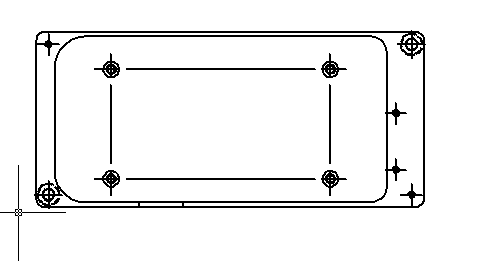
(Please refer to the mechanical drawing below for detailed dimensions of both the core switch and the module package.)
FAQ
Q: What is the primary advantage of using a MEMS optical switch over a mechanical switch for polarization-maintaining applications?
A: MEMS switches offer significantly faster switching speeds (typically milliseconds vs. tens of milliseconds for mechanical), higher reliability due to the absence of mechanical wear and friction, and a more compact form factor. While mechanical switches may offer slightly lower insertion loss, MEMS technology provides an excellent balance of speed, size, and optical performance, especially for systems requiring frequent switching or higher port counts.
Q: Can this switch be customized for other wavelengths, such as 1310nm or 1064nm?
A: Absolutely. As a leading optical switch manufacturer in China, Coreray specializes in customization. We can tailor the switch for different operating wavelengths, PM fiber types (e.g., Panda, Bow-tie), pigtail lengths, and connector styles (e.g., LC/APC, SC/PC) to meet your specific system requirements. Please contact our engineering team to discuss your needs.
Q: What does the "SMA interface" refer to, and why is it important?
A: The SMA interface denotes the type of electrical connector used to deliver the control signal to the MEMS driver. SMA connectors are known for their robustness, excellent shielding, and reliable connection, making them ideal for laboratory and industrial environments where noise immunity and secure connections are critical. It ensures that the drive voltage (5V TTL) is delivered cleanly to the MEMS actuator for precise switching.


Scan to add on WeChat


 中文
中文 EN
EN