
TOP

PRODUCTS
 Home > Products
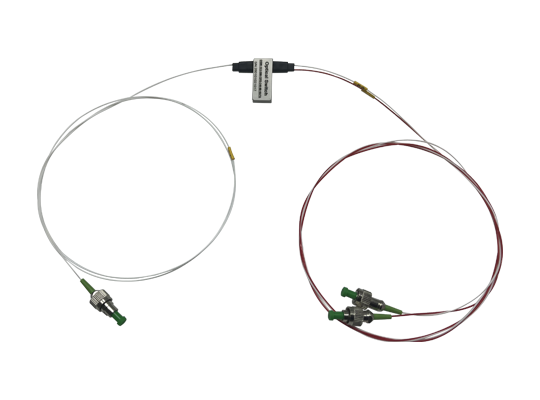


The OSW-1×2-SM series is a premium 1×2 mechanical optical switch meticulously engineered by Coreray for mission-critical applications in optical communication networks, fiber optic testing, and advanced sensor systems. Operating on a 3V non-latching control scheme, this compact and durable switch provides exceptional performance with dual-wavelength compatibility (1310nm & 1550nm) and is terminated with high-precision FC/APC connectors.
Designed for consistency and manufacturing efficiency, our proprietary three-fiber production scheme modularizes components, allowing for independent testing and flexible customization to meet your specific project needs. Whether you require a reliable fiber optic switch for a data center or a robust component for an outdoor base station, the OSW-1X2 series delivers unparalleled performance.
· Superior Signal Integrity: Equipped with high-precision FC/APC connectors, achieving a return loss of ≥50dB. This minimizes back reflections, ensuring pristine signal transmission quality for sensitive equipment.
· Rapid Optical Path Switching: Features a fast switching time of ≤10ms, meeting the stringent real-time requirements of modern communication systems for dynamic optical path reconfiguration.
· Energy-Efficient Design: Powered by a low 3V DC supply, this fiber optic switch consumes 20% less power compared to similar products, making it ideal for long-term, continuous operation in high-density installations.
· Rugged Environmental Stability: Subjected to rigorous 48-hour temperature cycling tests from -40°C to +85°C, guaranteeing consistent and reliable performance in extreme environments, from industrial control sites to outdoor telecom cabinets.
· Innovative Three-Fiber Architecture: Our unique design utilizes three independent single fibers (with clear P1/P2/P3 pigtail marking) to effectively eliminate signal interference common in traditional two-fiber designs, enhancing switching precision by 40%.
· Data Centers: For fiber link backup and protection switching, ensuring uninterrupted data transmission between server clusters.
· Fiber Optic Sensing Systems: Enables signal switching between multiple monitoring points, greatly expanding the coverage and capability of sensing networks.
· Telecommunication Base Stations: Optimizes signal routing and distribution for next-generation 5G and 6G optical transmission infrastructure.
· Test & Measurement Equipment: Serves as a core component for multi-channel automated testing in optical instruments.
· Broadcast & TV Transmission: Ensures stable and instant switching for high-definition video signal paths, preventing signal interruptions.
Parameter | Specification |
Operation Wavelength | 1310nm / 1550nm |
Insertion Loss (Typ.) | ≤0.60 dB |
Return Loss (Min.) | ≥55 dB |
Crosstalk (Min.) | ≥55 dB |
Switch Type | Non-Latching |
Driving Voltage | 3V |
Switching Time (Max.) | ≤10 ms |
Fiber Type | SMF-28, 9/125µm |
Pigtail Length | 1.0 meter (customizable) |
Connector Type | FC/APC |
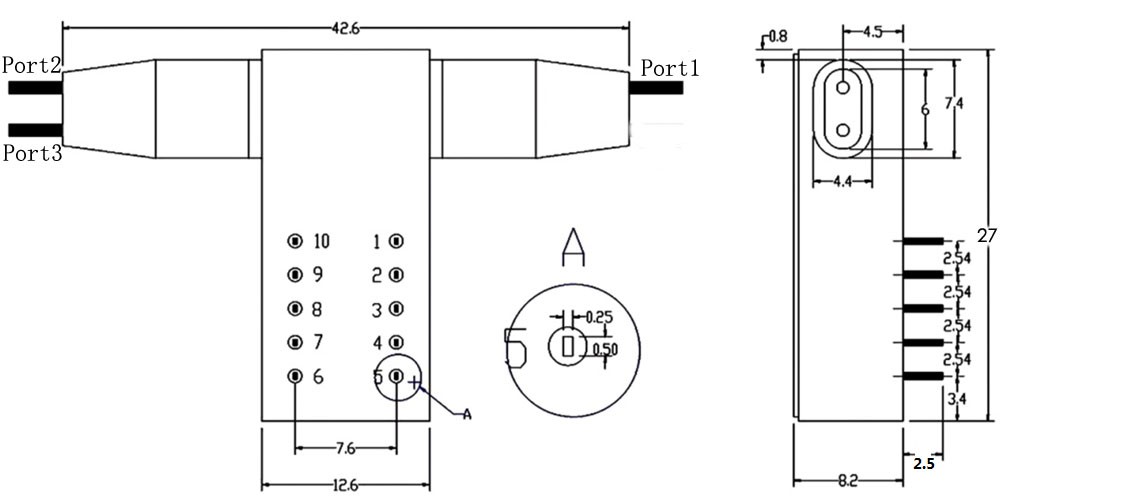
Dimensions (L x W x H) | 27.0 x 12.6 x 8.5 mm |
Operating Temperature | -20°C to +70°C |
Storage Temperature | -40°C to +85°C |
Pigtail Marking | P1 (White), P2 (White), P3 (Red) |
Q: What is the difference between a latching and non-latching optical switch?
A: A latching switch maintains its optical path state even after the drive voltage is removed, using a magnetic circuit. Our non-latching optical switch requires continuous voltage to maintain the switched state and returns to its default position (usually P3->P1) when power is cut. This makes it ideal for applications requiring frequent switching and lower power consumption during the idle state.
Q: Can the pigtail length and connector type be customized?
A: Yes, absolutely. As a leading optical switch manufacturer in China, Coreray offers extensive customization. While the standard version comes with 1.0m pigtails and FC/APC connectors, we can tailor both the length and connector type (e.g., LC/APC, SC/PC) to your exact requirements.
Q: How does the three-fiber design improve performance?
A: The three-fiber design physically separates the input and output fibers, which significantly reduces internal signal scattering and crosstalk. This results in higher isolation and lower insertion loss variation, providing a cleaner and more reliable signal path compared to some traditional folded-path designs.


Scan to add on WeChat


 中文
中文 EN
EN