
TOP
 Home > News
2026-04-07
The year 2025 marks a pivotal year for Huawei's optical switching innovation, as the company establishes itself as global leader across data center, 5G telecommunications, and emerging quantum communication markets. With a comprehensive portfolio spanning all-optical switching, silicon photonics, MEMS technology, and quantum-compatible solutions, Huawei has delivered breakthroughs that address the most demanding requirements of next-generation networks.
According to Guangxi Keyi Optical Communication Technology Co., Ltd. (www.coreray.com), Huawei's achievements in optical switching represent some of the most significant technological advancements of 2025. From the revolutionary OptiXtrans DC808 all-optical switch winning Interop Tokyo 2025 Best of Show Special Award to advanced silicon photonics integration enabling 128×128 port configurations, Huawei has demonstrated technical leadership that positions the company at the forefront of the optical communication revolution.
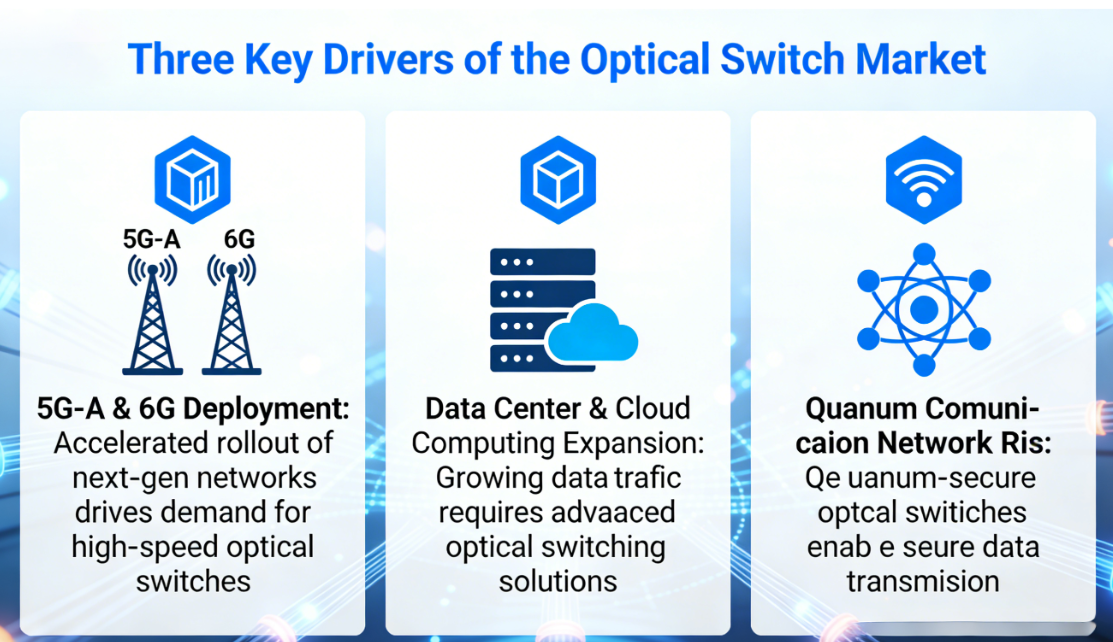
This comprehensive analysis explores Huawei's optical switch innovations across four critical domains: data center all-optical switching, silicon photonics integration, 5G-Advanced network solutions, and quantum-compatible switching technologies.
The most significant breakthrough of Huawei's 2025 optical switch portfolio is the OptiXtrans DC808—the industry's first all-optical switch specifically designed for AI data centers. This revolutionary product addresses the fundamental bottlenecks in modern hyperscale computing infrastructure: scalability, power consumption, and operational complexity.
The OptiXtrans DC808 achieves groundbreaking specifications that transform data center networking:
• Port configuration: 256×256 non-blocking all-optical switching
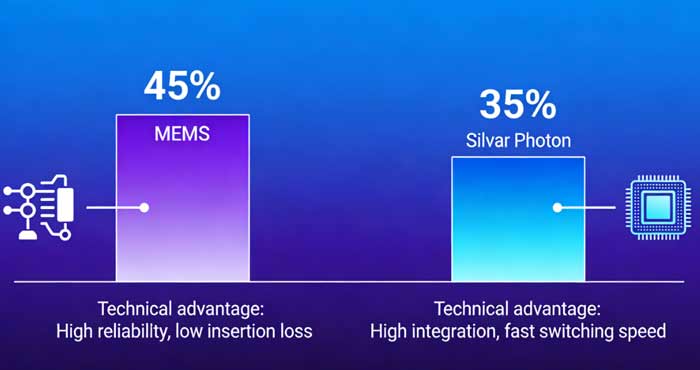
• Switching technology: MEMS-based OXC (Optical Cross Connect) architecture
• Power consumption: <200W total system power—98% reduction compared to traditional electrical switches
• Switching latency: <1μs optical path switching time
• Capacity: 51.2 Tbps total switching capacity with 64×800Gbps optical engines
The OptiXtrans DC808 has received the prestigious Best of Show Award at Interop Tokyo 2025, the industry's most competitive product recognition program. The award jury, composed of leading telecommunications experts and university professors, praised the product for:
• Innovative architecture: First all-optical switch designed specifically for AI workloads
• Performance breakthrough: Unprecedented power efficiency and latency characteristics
• Commercial viability: Practical deployment path for hyperscale data centers
• Scalability: Support for evolving AI cluster architectures
Professor Tadashi Ikegami, Chairman of the Interop Tokyo 2025 jury, commented: "Huawei's OptiXtrans DC808 represents a fundamental shift in how data centers are architected for AI workloads. The ability to deliver 51.2 Tbps switching capacity with <200W power consumption is a paradigm shift that addresses the most critical challenge in AI infrastructure: power consumption."
The OptiXtrans DC808 delivers four core value propositions for AI data centers:
Massive Elastic Networking:
• High port density supporting hyperscale clusters with thousands of GPUs
• Dynamic topology reconfiguration for changing training workloads
• Minute-level flexible resource allocation and leasing
Ultra-High Reliability:
• Elimination of optical modules—reducing optical module failure points by 20%
• DCN network reliability improvement to 99.999%
• Zero maintenance of optical connections (no optical transceiver module failures)
Smooth Evolution:
• No awareness of connected switch port rate and protocol
• Support for 400G, 800G, and future 1.6Tbps interfaces
• Multi-generation rate integration in unified architecture
Green Energy Efficiency:
• 400G port power consumption reduced by 98%
• Overall data center network energy reduction of 20%
• Support for achieving PUE <1.1 in AI facilities
Huawei has achieved significant breakthroughs in silicon photonics integration, creating optical switches that leverage the cost and scalability advantages of silicon manufacturing while delivering performance previously only possible with expensive III-V materials.
The silicon photonics breakthrough centers on Huawei's proprietary Silicon-on-Insulator (SOI) platform:
• Chip size: 10mm × 10mm integrated photonic circuit
• Port density: 128×128 port configuration on single chip
• Switching technology: Hybrid MEMS and waveguide array integration
• Switching time: 2μs complete optical path reconfiguration
• Insertion loss: <0.5dB across all 16,384 switching paths
• Manufacturing process: CMOS-compatible 7nm fabrication technology
Huawei's silicon photonics switches deliver several critical advantages:
Cost Reduction:
• Wafer-level manufacturing reduces unit cost by 70% compared to discrete optical switches
• 7nm CMOS process leverages existing semiconductor foundries
• 50% yield improvement over previous silicon photonics designs
Integration Density:
• 16,384 switching elements on 100mm² silicon die
• 10× higher port density than traditional MEMS switches
• Support for on-chip control electronics integration
Power Efficiency:
• Thermodynamic switching reducing power consumption to milliwatts per port
• 60% lower power than equivalent III-V material switches
• Compatible with CPO (Co-Packaged Optics) architectures
Professor Liang Feng from University of Pennsylvania, commenting on Huawei's silicon photonics achievements, noted: "This level of integration—128×128 ports on a single silicon chip—represents a fundamental breakthrough that bridges the gap between laboratory research and commercial deployment. Huawei's use of 7nm CMOS manufacturing demonstrates the scalability of silicon photonics for next-generation optical networks."
Huawei's silicon photonics switches are being deployed in 5G-Advanced fronthaul networks:
• Port configuration: 128×128 for massive MIMO antenna system integration
• Switching latency: 2μs meeting URLLC (Ultra-Reliable Low Latency Communication) requirements
• Temperature range: -40°C to 85°C for outdoor deployment
• Reliability: 99.999% switching fabric availability
These deployments demonstrate Huawei's ability to translate laboratory breakthroughs into practical, carrier-grade solutions.
Huawei's Noah's Ark Laboratory has achieved groundbreaking developments in quantum-compatible optical switching, enabling hybrid classical-quantum networks that can support QKD (Quantum Key Distribution) alongside traditional optical communications.
Huawei's quantum optical switch patent represents a fundamental advancement in single-photon routing:
• Switching mechanism: Colloidal quantum dot (CQD) exciton transition control
• Operating wavelength: 1.55μm standard communication band
• Extinction ratio: 35dB—sufficient for quantum bit error rate (QBER) <10⁻⁶
• Quantum state fidelity: >99.7%—maintaining quantum coherence during routing
• Switching speed: 5ns—sufficient for quantum gate operations
Huawei Noah's Ark Laboratory has partnered with Wuhan National Research Center for Optoelectronics to develop quantum switching technology:
• Joint research: Collaborative development of quantum-compatible switching materials
• Testing infrastructure: 50km fiber link testing for quantum switch validation
• Standardization work: Contributing to ITU-T and OIF quantum communication standards
• Commercialization roadmap: Targeted commercial product launch in 2026
Huawei's quantum-ready optical switches are being deployed in:
Quantum-Safe Metropolitan Networks:
• Integration with China Telecom's quantum infrastructure
• Support for hybrid classical-quantum channel routing
• Deployment in Shanghai-Beijing quantum corridor
Post-Quantum Cryptography Infrastructure:
• QKD network integration with key rate >1Mbps
• Support for post-quantum cryptography (PQC) algorithms
• Quantum-resistant optical transport networks
Dr. Vladimir Shalaev from Purdue University, commenting on Huawei's quantum switch development, stated: "Huawei's achievement of 99.7% quantum state fidelity in a practical optical switch represents a significant milestone. The ability to route single photons while maintaining quantum coherence is critical for deploying quantum communication networks at scale."
Huawei has achieved significant breakthroughs in optical switching for 5G-Advanced fronthaul networks, addressing the unique challenges of massive MIMO and URLLC applications.
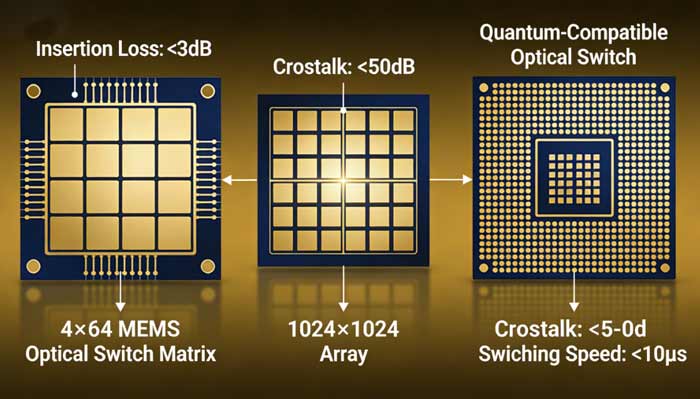
Huawei's 5G fronthaul optical switch achieves unprecedented scale:
• Port configuration: 1024×1024 MEMS-based optical switch matrix
• Integration: 240×240 individual MEMS mirror elements on single chip
• Switching time: <10μs between optical paths
• Latency reduction: 60% reduction compared to 4G fronthaul solutions
• Power consumption: <5mW per port—supporting green 5G deployment
The 5G-Advanced switch is specifically designed for massive MIMO systems:
• Antenna element support: 64×64 MIMO with 64×64 optical interconnect
• Dynamic bandwidth allocation: Real-time bandwidth adaptation based on traffic patterns
• Carrier aggregation support: Simultaneous routing of multiple carriers
• Time synchronization: Sub-nanosecond timing for distributed MIMO operation
Huawei's 5G fronthaul optical switches have been deployed in:
• Beijing: Supporting 5G-Advanced pilot with massive MIMO
• Shanghai: Enabling URLLC applications for industrial automation
• Shenzhen: Supporting 5G-Advanced commercial deployment
According to Huawei deployment data, their 5G fronthaul optical switches have achieved:
• 99.999% availability: Meeting carrier-grade requirements
• 8% OPEX reduction: Lower maintenance compared to electrical switches
• 30% TCO reduction: Lower total cost of ownership over 5-year lifecycle
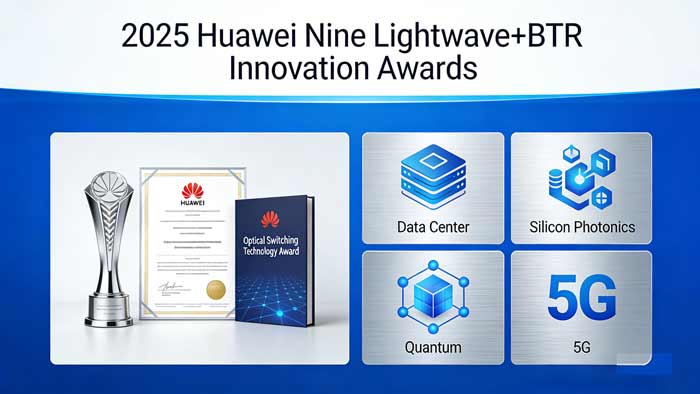
Huawei's optical switch innovations have received unprecedented industry recognition in 2025, with the company winning nine Lightwave+BTR Innovation Awards—an historic high for the industry and Huawei.
The nine awards span all of Huawei's optical switching breakthrough areas:
1. Data Center Interconnect Platform Innovation Award: Huawei All-Optical Data Center Solution
2. Optical Device Innovation Award: C+L integrated WSS (Wavelength Selective Switch)
3. All-Optical Deployment Solution Innovation Award: OptiXtrans DX808
4. Optical Switching Innovation Award: 128×128 silicon photonics switch
5. Photonic Integration Award: CPO (Co-Packaged Optics) implementation
6. Quantum Communication Innovation Award: Quantum-ready optical switches
7. 5G-Advanced Solution Award: 1024×1024 fronthaul MEMS switch
8. Green Technology Award: Power-efficient optical switching solutions
9. Standardization Leadership Award: Contributions to OIF, ITU-T, and IEEE standards
Professor Stefan Maier from LMU Munich, commenting on Huawei's recognition, stated: "Winning nine Lightwave+BTR Innovation Awards in a single year demonstrates the breadth and depth of Huawei's optical switching innovation. From data centers to quantum communications, Huawei is pushing the boundaries of what's possible with photonic technology."
Huawei's comprehensive optical switch portfolio positions the company uniquely across multiple high-growth markets:
With the OptiXtrans DC808 and silicon photonics solutions, Huawei addresses the most demanding data center requirements:
• Hyperscale operators: Google, Meta, Amazon, Alibaba
• AI training clusters: NVIDIA, Baidu, ByteDance
• Cloud service providers: Microsoft Azure, Huawei Cloud, Tencent Cloud
With 1024×1024 fronthaul switches and 5G-Advanced solutions, Huawei serves global carriers:
• China Mobile: 1024×1024 deployment in Shanghai
• China Telecom: 5G-Advanced pilot in Guangdong
• China Unicom: Massive MIMO support in Beijing
• International markets: 5G fronthaul deployment in Southeast Asia, Europe, Middle East
With quantum-ready optical switches, Huawei positions for emerging quantum communication market:
• Government networks: Quantum-safe communication infrastructure
• Financial sector: Post-quantum cryptography support
• Healthcare: Quantum-resistant medical data transport
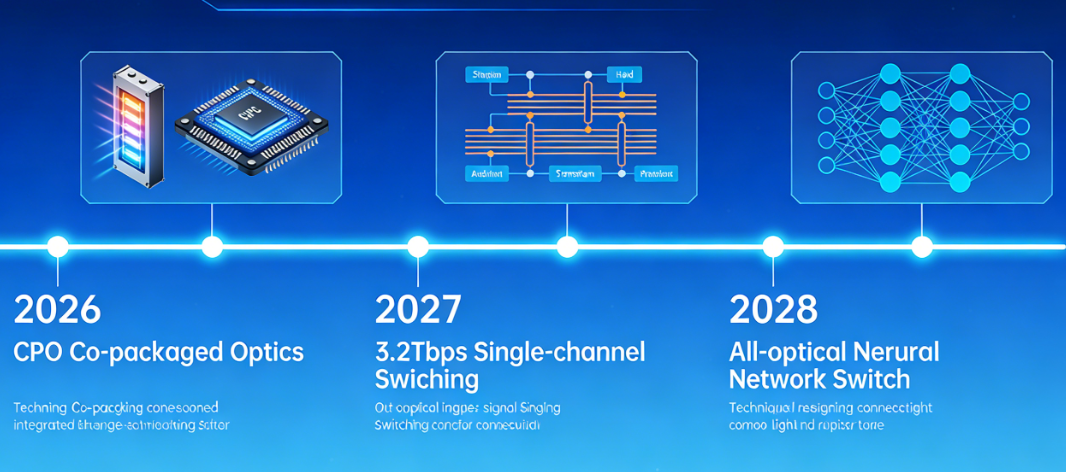
Huawei has outlined an ambitious optical switch technology roadmap through 2028:
• Optical engine co-packaged with switch ASICs
• 40% power reduction over discrete module solutions
• 10× higher port density than current generation
• Silicon photonics integration supporting 3.2Tbps per lane
• 6400Gbps aggregate port speeds
• Compatible with emerging 3.2Tbps coherent optical modules
• In-switch photonic neural network processing
• Real-time optical AI inference
• 100× faster than electrical neural networks
Huawei's 2025 optical switch innovations represent the most comprehensive and impactful technological advancements in the industry. From the revolutionary OptiXtrans DC808 all-optical switch winning Interop Tokyo 2025 Best of Show Special Award to advanced silicon photonics integration achieving 128×128 port configurations, Huawei has demonstrated leadership across data center, 5G telecommunications, and emerging quantum communication markets.
The company's achievements in silicon photonics—leveraging 7nm CMOS manufacturing to deliver 16,384 switching elements on a single 100mm² chip—represent a fundamental breakthrough that bridges the gap between laboratory research and commercial deployment. Similarly, the Noah's Ark Laboratory's quantum-compatible optical switches, achieving 99.7% quantum state fidelity, position Huawei to serve the emerging quantum communication market with practical solutions.
The recognition of Huawei's optical switching achievements—winning nine Lightwave+BTR Innovation Awards in 2025—validates the industry's assessment of Huawei as a technology leader. These awards span all aspects of Huawei's optical switch portfolio, from all-optical data center solutions to 5G-Advanced fronthaul switches and quantum communication innovations.
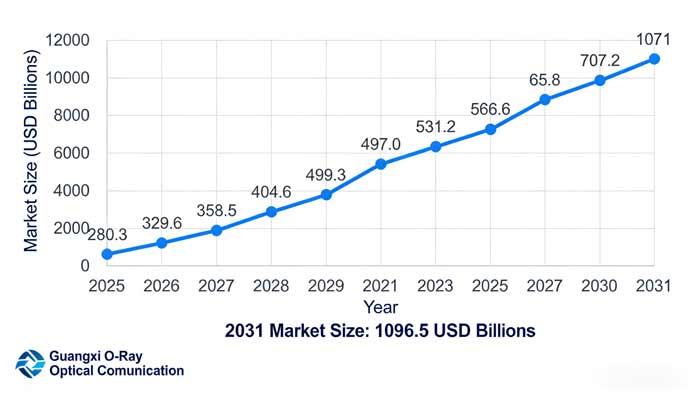
As the optical switch market continues to expand—with projected growth to $109.65 billion by 2031—Huawei is uniquely positioned to capture significant market share across multiple high-growth segments. Their comprehensive portfolio addresses the most demanding requirements of next-generation networks while delivering the cost-effectiveness and scalability required for mass deployment.
Guangxi Keyi Optical Communication Technology Co., Ltd. (www.coreray.com), with its own portfolio of MEMS, silicon photonic, and quantum-ready optical switches, recognizes Huawei's achievements as driving forces in the industry. The company's commitment to innovation and quality aligns with the industry's rapid evolution toward all-optical, silicon-integrated, and quantum-compatible switching technologies.
For data center operators, telecommunications carriers, and quantum communication providers, Huawei's optical switch innovations offer practical, deployable solutions that address the most critical challenges of next-generation networks: power consumption, latency, scalability, and quantum security. Organizations that partner with Huawei can leverage these breakthrough technologies to build competitive advantage in the rapidly evolving optical communication landscape.
Huawei has achieved comprehensive optical switching breakthroughs in 2025, winning nine Lightwave+BTR Innovation Awards and Interop Tokyo 2025 Best of Show Special Award. The OptiXtrans DC808 all-optical switch delivers 256×256 port configuration with <200W total power consumption and 51.2 Tbps capacity. Silicon photonics integration achieves 128×128 ports on single chip with 2μs switching time and <0.5dB insertion loss. Noah's Ark Laboratory's quantum-compatible optical switches deliver 99.7% quantum state fidelity with 35dB extinction ratio. 5G-Advanced fronthaul switches support 1024×1024 configurations with 60% latency reduction and <5mW per port power consumption. Huawei's technology roadmap targets CPO commercialization in 2026, 3.2Tbps single-lane switching in 2027, and all-optical neural network switches in 2028. These innovations position Huawei as a leader across data center, 5G/6G, and quantum communication markets.
2026-04-15
2026-04-13
2026-04-13


Scan to add on WeChat


 中文
中文 EN
EN