
TOP

PRODUCTS
 Home > Products
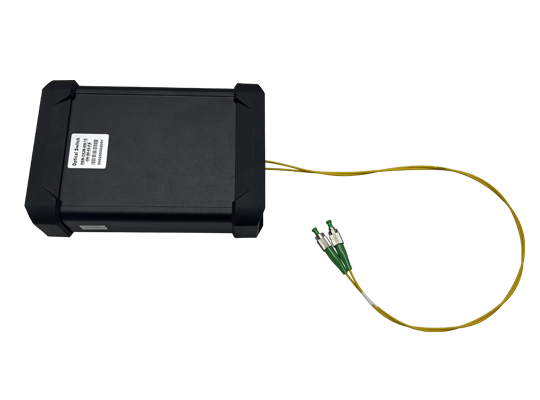


The OSW-2×2B-SM-15-5N-90-05-FA is a high-precision 4-channel variable optical delay line module, custom-engineered by Coreray Optical Communication, a leading Fiber Optic Switch manufacturer in China. This module integrates four 2x2B mechanical optical switches in a cascaded configuration to create a programmable delay line, specifically designed for advanced laboratory testing and complex optical link simulations.
Operating at the standard single-mode wavelength of 1550nm and featuring low-loss FC/APC connectors, this module provides selectable delay paths of 4m, 8m, 16m, and 32m. By controlling the state of each internal switch via RS232, users can achieve a total of 16 different delay combinations, with a maximum cumulative delay of 60 meters. This makes it an ideal tool for applications ranging from fiber optic sensing to optical network fault simulation.
Parameter | Specification | Note |
Wavelength | 1550nm | Single-mode fiber |
Insertion Loss | ≤0.8 dB (Typ. 0.5 dB) | Including connector loss |
Return Loss | ≥50 dB | minimal value |
Cross-talk | ≥50 dB | minimal value |
Control Interface | RS232 | Standard communication protocol |
Supply Voltage | 5V DC | Latching relay (maintains state) |
Fiber Type | 9/125μm | Single-mode (SMF-28) |
Pigtail Type | 0.9mm Loose Tube | Yellow jacket |
Connector Type | FC/APC | Standard on both ends |
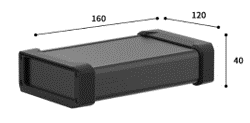
Dimensions (WxDxH) | 135 x 40 x 32mm | Aluminum housing |
Operating Temperature | -20°C ~ +70°C | Industrial grade |
This optical switch module utilizes a modular design, cascading four individual 2x2B switches through precision fusion splicing to achieve programmable delay.
The internal delay fiber configuration is as follows:
Stage 1 Switch: 4-meter delay fiber spliced between Port 2 and Port 4.
Stage 2 Switch: 8-meter delay fiber spliced; input from Stage 1 (Port 3) to Stage 2 (Port 1).
Stage 3 Switch: 16-meter delay fiber spliced; input from Stage 2 (Port 3) to Stage 3 (Port 1).
Stage 4 Switch: 32-meter delay fiber spliced; input from Stage 3 (Port 3) to Stage 4 (Port 1).
The cascaded design results in a total base delay of 60 meters. By switching the state of each stage, the optical path can be routed through any combination of these delay fibers, offering 16 unique delay states.
l Ultra-Low Insertion Loss: High-precision collimators and premium relays ensure minimal signal degradation, with typical loss below 0.5dB.
l High Isolation & Reliability: With return loss and cross-talk ≥50dB, the module guarantees signal integrity and prevents crosstalk between channels. As a reliable mechanical optical switch, it ensures robust performance.
l Programmable Delay Control: The RS232 interface allows for remote and automated control, enabling users to dynamically select delay paths. This functionality is critical for simulating various distances in applications involving MEMS optical switch or mechanical switch technologies.
l Industrial-Grade Durability: The 5V latching relay driver maintains the optical path state even after power loss, ensuring stability. The module operates reliably across a wide temperature range (-20°C to +70°C).
l Precision Fiber Craftsmanship: Each delay line is cut to exact lengths and fusion-spliced to minimize loss, all housed in a compact and durable aluminum enclosure.
This 4-channel variable optical delay line is a versatile tool for:
l Fiber Optic Sensing: Simulates long-distance signal transmission for calibrating distributed sensing systems, fiber optic gyroscopes, and hydrophones without needing kilometers of physical fiber.
l Optical Device Testing: Generates precise, controlled delays for testing the time-domain response of optical modules, amplifiers, and WDMs. It is an essential instrument for any optical switch China based testbed.
l Radar & Electronic Warfare: Acts as a core delay unit in optical beamforming networks and delay lines for radar and EW systems, leveraging the low loss and high bandwidth of fiber optics.
l Research & Education: Provides a hands-on platform for university labs to demonstrate principles of optical switching, time-division multiplexing, and signal processing.


Scan to add on WeChat


 中文
中文 EN
EN