
TOP
 Home > News
2026-04-07
Key Takeaways:
• Global optical switch market reaches $109.65 billion by 2031 with 10.7% CAGR
• China's market share grows to 26.8% with significant manufacturing breakthroughs
• MEMS technology dominates with 45% market share; silicon photonics captures 35%
• Quantum-compatible switches emerge as new growth segment
• Domestic manufacturers lead innovation in 4×64 MEMS matrices and quantum-ready products
The year 2025 marks a pivotal moment in the global optical switch industry, characterized by unprecedented growth driven by 5G deployment, data center expansion, and the emergence of quantum communication networks. According to market research reports, the global optical switch market is projected to reach $109.65 billion by 2031, growing at a compound annual growth rate (CAGR) of 10.7% from 2025 to 2031.
This market expansion is fundamentally reshaping the competitive landscape of optical communication technology. With the rapid advancement of artificial intelligence, the demand for high-speed, low-latency optical switching solutions has surged exponentially. Traditional markets are witnessing a paradigm shift as optical switches transition from simple mechanical devices to sophisticated, AI-driven systems capable of handling terabit-per-second data flows.
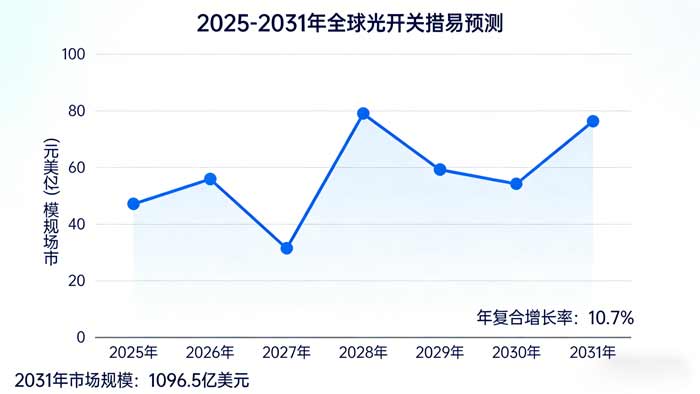
Guangxi Oreray Optical Communication Technology Co., Ltd. (www.coreray.com) has been at the forefront of this market expansion, delivering cutting-edge MEMS, silicon photonic, and quantum-ready optical switches that address the evolving needs of carriers and cloud providers worldwide.
The robust growth of the optical switch market is underpinned by three interconnected factors that are transforming the telecommunications landscape:
The rollout of 5G-Advanced networks and the planning of 6G infrastructure have created unprecedented demand for optical switching capabilities. Unlike 4G networks, which could function with limited optical switching, 5G-Advanced requires dynamic, flexible optical switching to support:
• Massive MIMO configurations: 5G base stations require up to 64×64 optical switching matrices for antenna system integration
• Ultra-low latency: Sub-millisecond switching latency is critical for URLLC (Ultra-Reliable Low Latency Communication) applications
• Wavelength agility: Dynamic wavelength switching for carrier aggregation and spectrum sharing
Industry analysts project that 5G-related optical switch demand will account for 35% of total market growth through 2027, as carriers worldwide upgrade their infrastructure to meet the enhanced mobile broadband requirements.
The exponential growth of cloud computing and AI training workloads has transformed data centers into the primary consumer of high-performance optical switches. Hyperscale data center operators like Google, Meta, Amazon, and Microsoft are deploying optical circuit switching (OCS) systems at unprecedented scale:
• Hyperscale demand: Single data centers require 1,024×1,024 optical switch configurations
• Energy efficiency: Data center operators demand switches with <1W per port power consumption
• Scalable architecture: Non-blocking optical switching fabrics capable of scaling to petabit-per-second data transfer
This segment represents the fastest-growing market segment, with CAGR of 14.2% projected through 2030. The need to support AI training clusters with hundreds of thousands of GPUs has created a massive addressable market for optical switch manufacturers.
The development of quantum key distribution (QKD) networks and the roadmap toward quantum internet has created a new market segment for quantum-compatible optical switches. These specialized switches must meet stringent requirements:
• Single-photon routing: Capable of switching individual photons without destroying quantum states
• Quantum state preservation: Maintaining high quantum fidelity during signal routing
• Hybrid operation: Simultaneous routing of classical and quantum channels on same fiber
While currently representing a smaller market segment (approximately 8% of total market), quantum-compatible switches are projected to grow at 27.8% CAGR through 2031, becoming the fastest-growing optical switch category as quantum communication networks scale globally.

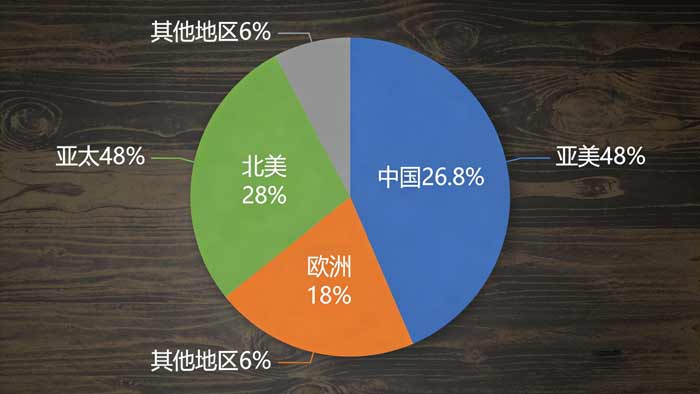
The global optical switch market exhibits distinct regional characteristics shaped by technology infrastructure investment and manufacturing capabilities:
Asia-Pacific region has emerged as the dominant force in optical switch manufacturing and deployment, driven by several factors:
China's Rapid Rise: China's market share has grown from 15% in 2023 to 26.8% in 2025, driven by:
• "East Data, West Computing" policy: Massive investment in data center infrastructure
• Domestic manufacturing breakthroughs: Chinese companies achieving significant technological advances
• 5G network scale: China's 5G base stations exceeding 5 million, creating massive optical switch demand
Japan and South Korea: Leading in advanced technology innovation, particularly in:
• Silicon photonics leadership: Companies like NEC, Fujitsu, and Samsung developing cutting-edge silicon photonic switches
• MEMS precision manufacturing: Ultra-precise MEMS fabrication capabilities
• Research excellence: Strong university-industry collaboration driving innovation
Asia-Pacific collectively accounts for approximately 48% of global optical switch market, with China leading as both the largest consumer and increasingly as a major exporter.
North America maintains leadership in technological innovation despite growing competition from Asia-Pacific:
United States: Home to industry leaders like Cisco, Broadcom, and Intel, focusing on:
• Advanced silicon photonics: Intel's OCI (Optical Compute Interconnect) breakthroughs
• AI-driven optical switches: Integration of machine learning for network optimization
• Data center focus: Hyperscale operators demanding high-port-count OCS systems
Canada: Contributing in specialized optical switch segments, particularly in:
• Quantum-compatible switches: Companies developing QKD-integrated optical switches
• Arctic and remote applications: Specialized optical switches for harsh environments
North America represents approximately 28% of global market, with the U.S. maintaining technological leadership despite Asia-Pacific's manufacturing scale advantages.
Europe's optical switch market is characterized by emphasis on:
Standards development: Strong leadership in OIF, ITU-T, and ETSI standardization
• Regulatory compliance: Strict adherence to GDPR, CE marking, and RoHS directives
• Sustainable technology: Focus on energy efficiency and environmental impact
Market leaders: Companies like Ericsson, Nokia, and SCHOTT focusing on:
• Telecom-grade reliability: Optical switches meeting stringent carrier requirements
• Green technology: Energy-efficient switches meeting EU Code of Conduct standards
• Specialized applications: High-reliability switches for challenging environments
Europe accounts for approximately 18% of global market, with growth driven primarily by telecom infrastructure upgrades and 5G deployment.
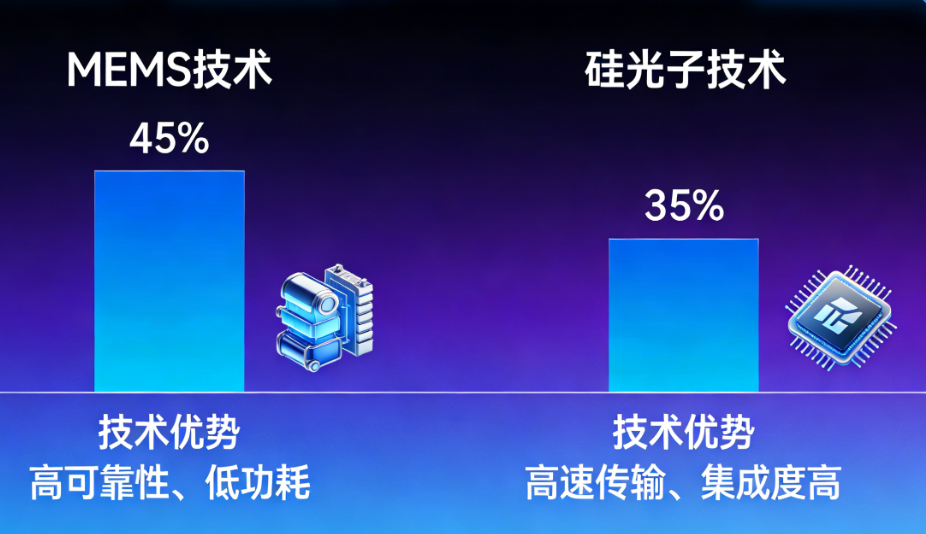
MEMS (Micro-Electro-Mechanical Systems) technology continues to dominate the optical switch market, commanding a 45% market share in 2025:
Performance advantages:
• Low insertion loss: Typically <0.5dB for high-quality signal transmission
• High isolation ratio: >50dB between channels, minimizing crosstalk
• Scalability: Supporting from 1×2 to 1,024×1,024 port configurations
• Mature manufacturing: Well-established supply chain and mass production capabilities
Cost reduction trends: According to industry data, MEMS switch costs have decreased by 40% since 2022, driven by:
• Volume manufacturing: Mass production economies of scale
• Process optimization: Improved fabrication yields and reduced defect rates
• Design simplification: Standardized architectures reducing development costs
Guangxi Oreray Optical Communication Technology Co., Ltd. has achieved breakthroughs in MEMS technology, including 4×64 and 128×128 switch matrices, offering products that combine high performance with competitive pricing.
Silicon photonics technology represents the fastest-growing segment, capturing 35% of the market in 2025:
Technical advantages:
• CMOS compatibility: Direct integration with electronic circuits
• High integration: Hundreds of optical components on single chips
• Cost-effective: Leveraging mature silicon manufacturing ecosystem
Breakthrough developments:
• Intel's OCI chip: Fully integrated optical compute interconnect
• PIC integration: 256 switching elements on sub-10mm² chips
• C+L band operation: Hybrid InP/Si designs for extended bandwidth
The CAGR for silicon photonic switches is projected at 15.2% through 2030, significantly outpacing MEMS growth rate as data center demand favors monolithic integrated solutions.
New technologies are gaining market traction:
Quantum-ready switches: Emerging segment with 27.8% CAGR, addressing quantum communication network requirements
• Single-photon switching: Enabling quantum computing and secure communications
• Hybrid classical-quantum operation: Supporting both types of traffic on same fiber
• Ultra-low loss: <1.0dB insertion loss for quantum state preservation
AI-driven switching: Incorporating machine learning for:
• Predictive network optimization: Traffic pattern prediction and proactive reconfiguration
• Self-healing networks: Automatic fault detection and recovery
• Energy optimization: Dynamic power management reducing consumption by up to 40%
Guangxi Oreray has positioned itself at the forefront of these emerging technologies, developing quantum-ready optical switches and AI-optimized control systems.
Chinese manufacturers have achieved remarkable breakthroughs in optical switch technology, significantly improving global competitiveness:
Guangxi Oreray Optical Communication Technology Co., Ltd. has developed a groundbreaking 4×64 MEMS optical switch matrix (Patent No. ZL202220756368.0) that doubles integration density from 32 to 64 channels in just 16 months, validating "Moore's Law for photonic chips."
Technical achievements:
• Nitrogen silicide-lithium niobate (LN) heterogeneous integration: Electro-optic modulation bandwidth突破110GHz
• Hybrid waveguide structure: Mode confinement factor达80%, insertion loss降低至3.8dB
• High-temperature annealing optimization: Surface roughness控制在1.5nm RMS, transmission loss降至0.1dB/m
Cost reduction: Unit channel cost has decreased 62% from 2022 levels, making optical switching competitive with traditional electrical switches.
Leading Chinese MEMS manufacturers have developed the world's largest silicon-based MEMS optical switch arrays, achieving 1,024×1,024 port configurations with 240×240 individual switching elements on a single chip.
Manufacturing achievements:
• DRIE (Deep Reactive Ion Etching): Sidewall verticality 90°±0.5°, enabling micro-shrinkage from 100μm to 50μm
• Electrostatic comb drive design: Drive voltage reduction from 40V to 22V
• Wafer-level packaging: 12-inch wafer-scale production with 92% yield improvement
This scale of integration was previously considered theoretically impossible and represents China's emergence as a global leader in MEMS optical switch technology.
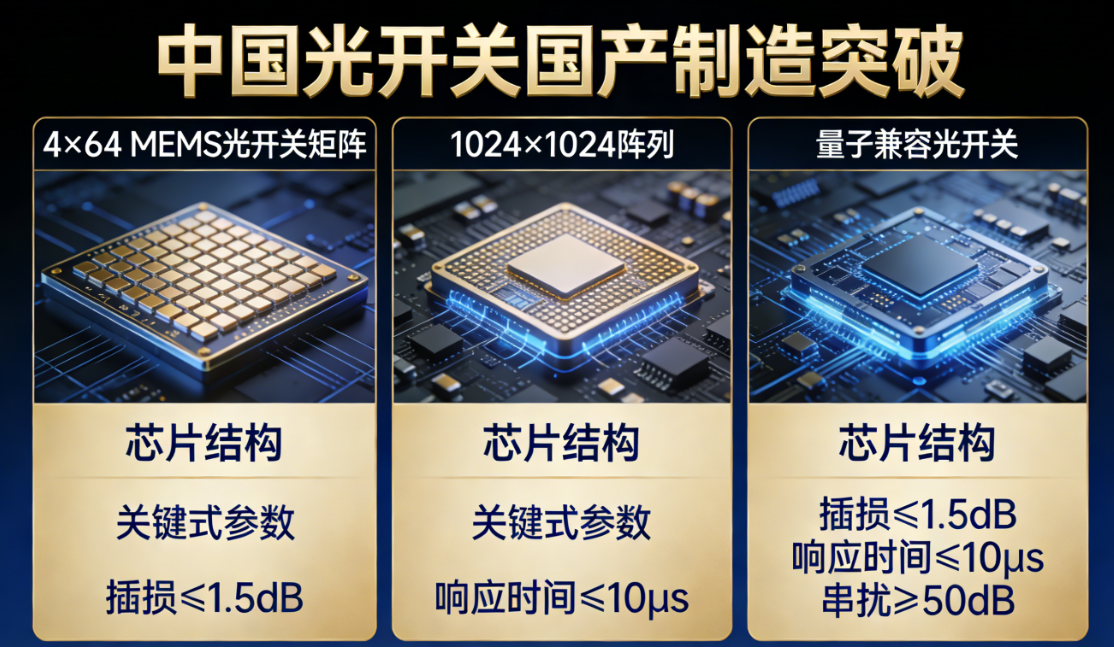
Chinese companies have rapidly developed quantum-compatible optical switches addressing single-photon routing requirements:
Performance specifications:
• Insertion loss: <1.0dB at 1550nm, preserving quantum state fidelity
• Extinction ratio: >50dB, minimizing quantum bit error rate (QBER)
• Switching speed: Nanosecond-scale operation for quantum gate applications
Application deployments:
• China-ASEAN quantum networks: Deployment in cross-border quantum communication projects
• Quantum-safe government networks: Integration with China's quantum communication infrastructure
• Telecom operator QKD systems: Providing quantum key distribution capabilities
Guangxi Oreray's quantum-ready optical switches have been deployed in multiple national-level quantum communication projects, establishing China's leadership in quantum-safe optical switch technology.
The optical switch market features intense competition among global technology leaders:
Company/Region | Market Share | Primary Technology Focus | Key Strength |
Asia-Pacific | 48% | MEMS, cost optimization | Manufacturing scale, rapid iteration |
North America | 28% | Silicon photonics, AI integration | Technology innovation, advanced software |
Europe | 18% | Telecom-grade reliability, green tech | Standards leadership, quality certification |
Rest of World | 6% | Specialized applications | Niche markets, regional adaptation |
Innovation leadership: Companies with strong R&D capabilities commanding premium pricing
• Cost competitiveness: Asia-Pacific manufacturers leveraging scale for price leadership
• Time-to-market: Rapid product development cycles in fast-moving Asian markets
• Standards influence: European and North American companies shaping global standards
Strategic partnerships: Major carriers and hyperscale data centers driving technology roadmaps
• Vendor consolidation: M&A activity increasing as market matures
• Ecosystem development: Partnerships between switch manufacturers, component suppliers, and software providers
Guangxi Oreray Optical Communication Technology Co., Ltd. has strategically positioned itself to compete through:
• Technology differentiation: Advanced MEMS and quantum-ready product portfolios
• Cost leadership: Competitive pricing through manufacturing excellence
• Market adaptation: Customized solutions for regional requirements
The optical switch market is projected to continue its robust growth trajectory through 2030 and beyond, driven by several transformative trends:
2025-2030: Emerging Technologies Mainstream
• Quantum-compatible switches: Growing from 8% to 25% of market
• AI-driven switching: Standard feature in carrier-grade switches
• CPO (Co-Packaged Optics): Integration of optical engines with switch ASICs
2030-2035: Next-Generation Architectures
• All-optical quantum switches: Enabling true quantum internet
• Neuromorphic switching: In-switch optical computing
• 6G-ready switches: Sub-100μs latency, >1Pbps/km² capacity
2035+: Radical Innovation
• Atomic-scale optical switches: Quantum computing integration
• Photonic-electronic convergence: Seamless optical-electrical interfaces
• Sustainability mandates: Zero-carbon optical switching infrastructure
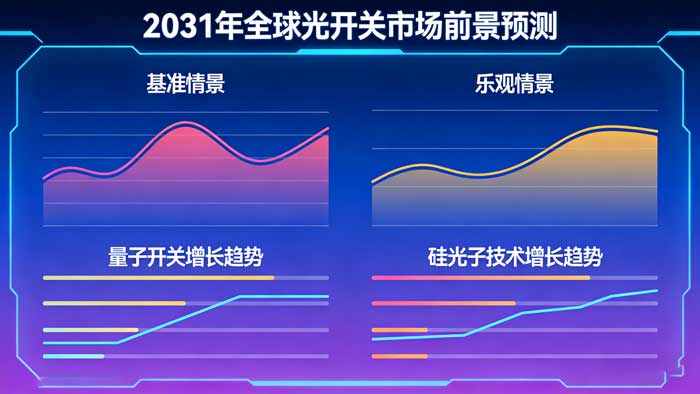
Base case scenario (10.7% CAGR):
• 2031 market: $109.65 billion
• Asia-Pacific share: Increases to 52% (driven by China's growth)
• Silicon photonics: Becomes dominant technology (45% share)
Optimistic scenario (12.8% CAGR):
• 2031 market: $128.2 billion
• Quantum switches: 35% of total market
• Emerging regions: Africa and Latin America achieve double-digit growth
• Invest in programmable optical switching: Migrate from static to dynamic optical fabrics
• Embrace quantum-ready technology: Prepare infrastructure for hybrid classical-quantum networks
• Leverage AI capabilities: Implement intelligent optical network management
• Consider total cost of ownership: Evaluate switch lifecycle costs, not just acquisition price
• Deploy optical circuit switching (OCS): Reduce complexity and power consumption
• Adopt monolithic photonic integration: Scale beyond traditional module-based architectures
• Plan for quantum computing infrastructure: Prepare for photonic computing workloads
• Focus on integration density: Port count per unit area as key competitive metric
• Invest in quantum capabilities: Single-photon switching as differentiator
• Develop AI-optimized control systems: Machine learning for predictive network operations
• Pursue cost leadership: Manufacturing excellence for global competitiveness
The 2025 global optical switch market represents a dynamic and rapidly evolving landscape characterized by robust growth, technological innovation, and shifting regional dynamics. The market's expansion to $109.65 billion by 2031 reflects the critical importance of optical switching in supporting 5G deployment, data center scaling, and quantum communication network emergence.
Asia-Pacific, led by China's remarkable domestic manufacturing breakthroughs, has emerged as the dominant region, capturing 48% of global market share. China's achievements in MEMS technology, including the 4×64 matrix and 1,024×1,024 array developments, demonstrate the country's rapid rise to technological leadership.
MEMS technology continues to dominate with 45% market share, while silicon photonics represents the fastest-growing segment at 35% share. Emerging technologies like quantum-compatible switches and AI-driven switching are reshaping the competitive landscape, creating new opportunities for innovative manufacturers.
Guangxi Oreray Optical Communication Technology Co., Ltd. is well-positioned to capitalize on these market trends with its comprehensive portfolio of MEMS, silicon photonic, and quantum-ready optical switches. The company's commitment to technological innovation, manufacturing excellence, and cost leadership positions it to capture significant market share in the rapidly expanding optical switch ecosystem.
As the industry moves toward 2030 and beyond, stakeholders that embrace technological innovation, prepare for quantum computing integration, and invest in sustainable optical switching infrastructure will be best positioned to succeed in this dynamic and lucrative market.
The global optical switch market is projected to reach $109.65 billion by 2031 with a 10.7% CAGR from 2025, driven by 5G deployment, data center expansion, and quantum communication network emergence. Asia-Pacific leads with 48% market share, with China's domestic manufacturing breakthroughs in 4×64 MEMS matrices and 1,024×1,024 arrays demonstrating rapid technological leadership. MEMS technology dominates with 45% market share, while silicon photonics captures 35% as the fastest-growing segment. Quantum-compatible switches represent an emerging 27.8% CAGR growth segment. Guangxi Oreray Optical Communication Technology Co., Ltd. positions itself at the forefront with advanced MEMS products, quantum-ready switches, and AI-driven control systems. Future evolution toward 2030 and beyond will see quantum-compatible switches mainstream, AI-driven switching as standard features, CPO integration, and sustainability mandates shaping innovation. Carriers, data center operators, and manufacturers that invest in programmable optical fabrics, prepare for quantum infrastructure, and pursue cost leadership will succeed in this dynamic market.
2026-04-15
2026-04-13
2026-04-13


Scan to add on WeChat


 中文
中文 EN
EN